Thursday, November 24, 2016

The Future of the Field: From trade school to the job site, the impact of technical education

Paul Tse, 30, isn’t afraid to admit that he wasn’t the best student in high school — he even told Congress. In May, Tse testified before the U.S. House of Representatives Committee on Education as part of a push by the Associated Builders and Contractors to bolster spending for the Carl D. Perkins Vocational and Technical Training Act, which aims to improve technical training opportunities.
In his statement, Tse, who emigrated with his family from Hong Kong to Montgomery County, MD, in 1996, explained that enrolling in the HVAC program at the Thomas Edison High School of Technology, in Silver Spring, MD, gave him necessary direction. “Spending my mornings in a typical classroom and afternoons at Edison, I was introduced into the world of construction and the skilled trades,” he told Congress.

A few weeks before he graduated, Tse was offered a job as an apprentice with local contractor Shapiro & Duncan Mechanical Contractors, in Rockville, MD, attending the Air Conditioner Contractors of America apprenticeship program in the evenings. “Even before my peers packed up their cars and headed out for freshman move-in day, I accepted a [position] and got right to work,” he said in his statement.
We talked with Tse, today a project manager with Shapiro & Duncan, about how he’s forging a path in the industry, the role of technical education today and what it was like to share his story with Congress.

As your friends were heading off to two- and four-year colleges, what did you think of your decision to pursue a trade?

TSE: It was nerve-wracking. Everybody was going to go tour different colleges and talking about their campuses and so on. I had nothing to show for it. To me, I was taking a big risk. I wasn't sure what the road ahead was going to be like. Nobody had told me whether it was going to be easy or if it was going to be hard, or if I was going to have a decent-paying job. All those things were unknown to me.

What did your instructors say about the decision to go into the apprenticeship program?


TSE: My teachers were positive. They were all tradesmen who had retired or stopped working in the trade to become teachers. They were all like: "You can definitely get out of here and be able to find a job right away. That’s a skill set that's going to stick with you for the rest of your life."

What are some of the biggest takeaways from your four-year apprenticeship?

TSE: Showing up on time and being prepared for whatever you're doing that day, as well as your craftsmanship — putting pride in your work. Not only does that show to your mentors and your superiors but, at the end of the day, it also shows to your customer, which will reflect on how you do with your supervisors and your mentors. Also, being prepared to learn every single day. You have no idea what you're going to encounter on your next project or even the following day on the same project.

Can you describe the experience of testifying in front of Congress on the importance of technical training?

TSE: It was very scary. The opportunity came up randomly through the ABC. It was a normal day of work for me and then I got a phone call, which became a phone interview, which eventually evolved into going in front of the panel to testify. They were looking for a success story [for technical training programs].


Did you realize you were a “success story” before they told you?

TSE: Not really. I just think I'm a normal American who immigrated to the States and this is, to me, the American Dream. Starting out with next to nothing and getting that education you're looking for, getting out of your education without accruing debt and then having a normal life.

After the testimony, did you find that your position on the role of technical training and mentoring changed?

TSE: It did, a little bit. After everybody told me how they felt about my testimony, I was a little shocked because I didn't think I was doing anything special. I thought this was a normal path, and that's when I started hearing that a lot of these other people still have a bad taste in their mouth of looking at construction workers as blue collar, inappropriate, disrespectful, uneducated. But that’s not the reality. The path of going down a four-year technical program in lieu of a four-year or two-year college should be open to everyone, not just people who couldn't make it in school.

What kind of mentoring opportunities have been available to you?

TSE: I would consider myself extremely lucky in terms of having mentors in this trade. A couple of incredible individuals at Shapiro & Duncan have taught me from 75% to 80% of what I know today. They took my hand and showed me how to do the things in the field. And then whatever I did by hand during the day, I went into school at night [as a part of the apprenticeship program] to get a more technical explanation, which reinforced my background of this trade.
I was never the best student in high school, and going into the classroom made me cringe a little bit. But in this case, it was encouraging. It was different than my high school career because whatever I learned during the day by hand, I was getting the explanation that night. It was like two pieces of a puzzle and a light bulb coming on.

What do you think the industry could be doing better in terms of bring up younger people through the ranks?

TSE: Awareness and advertisement. Being able to explain to kids that being a construction worker [is a positive], that's step one. Step two would be having school systems be more open to having contractors go to their school to show kids that there are apprenticeship programs that they can go into and they're not going to owe anybody a dime and are getting a skill set that they can take anywhere.

Where do you see yourself in 10 years?


TSE: My hope is that I will still be here at Shapiro & Duncan, and for the most part doing something similar but maybe at a higher level, like looking at multiple projects at a time as a senior project manager or some type of project executive. But maybe 10 years is too soon. Maybe I need more time.

How do you move a 140-year-old synagogue? Very carefully

It wasn't a fast or long ride, but it was a significant one.

A sophisticated system of hydraulics and steady wheels going about 1 mph moved the 140-year-old former Adas Israel Synagogue about 30 feet from its Third and G streets NW location on Thursday. The relocation clears the way for the continued construction of Capitol Crossing, Property Group Partners' $1.3 billion, 2.2 million-square-foot development atop I-395
This is the second time the building — currently home to the Albert and Lillian Small Jewish Museum — has been relocated. In 1969, after Metro purchased the entire block near Judiciary Square, a group of Jewish historians petitioned to save it. An act of Congress cleared the way, and the synagogue was then moved from Sixth and G streets NW to Third and G.
“It’s not every day you see a building as historically significant and important to the region as this one relocated for a second time,” Bob Braunohler, Property Group Partners regional vice president, said in a statement. “We are pleased to support this effort that gives the synagogue a bigger and better location that will benefit future generations of Washingtonians.”
There is a third move in the building's future. In about 2 1/2 years, the synagogue will be relocated to Third and F streets NW, atop a Capitol Crossing parking garage. There, it will be part of a new, larger museum complex. Until then, the building will be closed to the public as it rests on a steel platform.
"This is an exciting day for the Jewish community and for Washington in general," Renaissance Centro founder Albert "Sonny" Small Jr., whose parents' names adorn the museum, said at the move. Small's grandfather, also named Albert Small, was important in the fight to save and move the building 46 years ago.
Thursday's move cost about $500,000, Property Group Partners said.
The synagogue was built in 1876 by German immigrants. Original construction cost: $4,000. In 1908, the first Adas Israel congregation moved out and the building became a series of storefronts.

Wednesday, November 23, 2016

How to Keep Buildings From Killing Hundreds of Millions of Birds a Year

ARCHITECTS’ GROWING AFFINITY for glassy buildings has given the world better views, more natural light, sexier skylines—and a lot of dead birds. The US Fish and Wildlife Service estimates about 750 million birds perish annually flying into glass façades, which can be hard to distinguish from open airspace. The problem is so bad in some places that skyscraper owners hire workers to remove expired birds from the bottoms of their buildings.


Guy Maxwell, a partner at New York-based Ennead Architects, is on a mission to mitigate this fowl holocaust. A bird lover his entire life, he first became aware of architecture’s deadly impact on avifauna 15 years ago, shortly after the completion of his firm’s Rose Center for Earth and Space at NYC’s American Museum of Natural History. The enormous glass cube afforded unimpeded views of the spherical Hayden Planetarium within, but was a deadly invisible barrier to birds. Maxwell has been working to protect feathered species ever since.

Working with him is an informal circle of anti-collision advocates that includes members of the American Bird Conservancy, New York City Audubon, New Jersey Audubon, and the Bird Safe Glass Foundation. (“It really takes a gang of merry pranksters to pull this off,” says Maxwell.) Together, they’ve made progress on bird-safe research, bird-safe building regulations, bird-safe glass, and bird-safety awareness, spurring changes that have already had a large, ahem, impact.

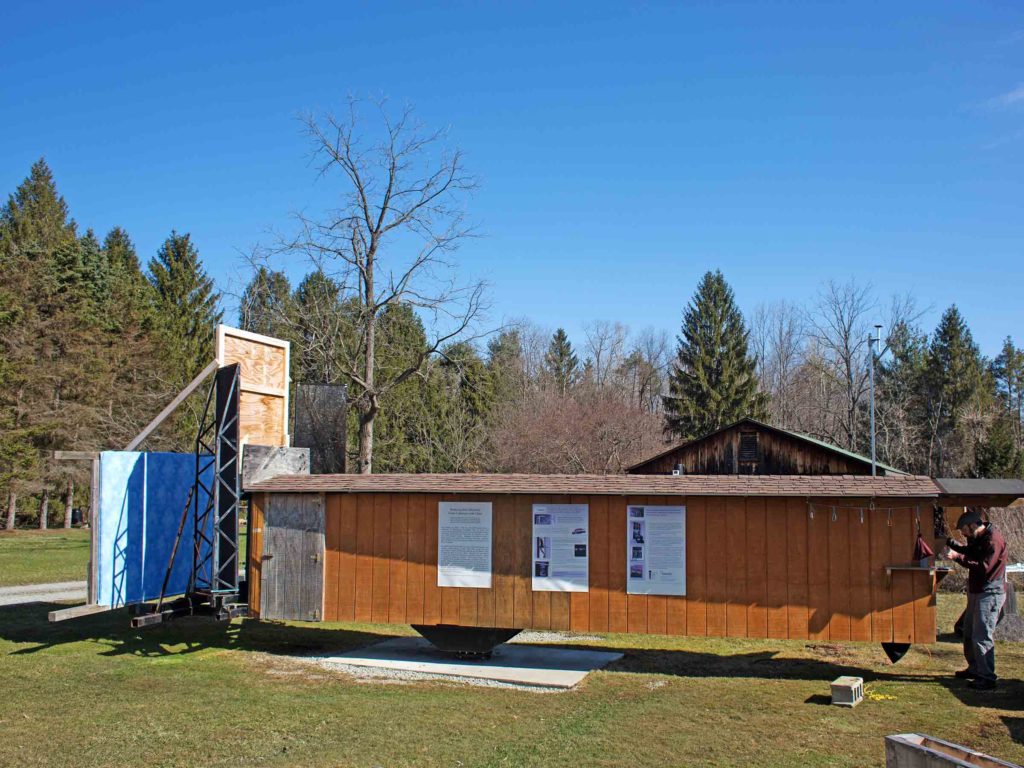
Among their recent accomplishments is the American Bird Conservancy’s creation of two avian research facilities—one at the Powdermill Nature Reserve, about an hour outside of Pittsburgh, the other inside a modified shipping container at the Bronx Zoo. (The Bronx tunnel’s design was overseen, in part, by Maxwell and his colleagues at Ennead’s research-intensive division, Ennead Lab.) Spearheaded by American Bird Conservancy Bird Collisions Campaign Manager Christine Sheppard, these testing tunnels are the only ones of their kind in the US, and allow researchers to investigate which glass treatments and lighting conditions birds will fly toward or avoid. They’ve learned, for instance, that birds won’t try to fly through vertical line patterns that are less than four inches apart, and that line patterns tend to be more effective at preventing collisions than dotted ones.


Using this knowledge, Maxwell, Sheppard, and their confederates have consulted with glass manufacturers like Viracon, Guardian, Bendheim, and Arnold Glas to help produce products like ceramic frit patterns and UV coatings—treatments that are visible to birds and can alert them to the presence of dangerous physical barriers.

The group’s biggest policy achievement came in 2011, when it partnered with the US Green Building Council to launch a LEED pilot credit #55 for incorporating “bird collision deterrence” into new buildings. The goal: Make buildings as visible to birds as possible, through glass technologies, exterior building treatments like screens and louvers, and decreased night lighting levels. Maxwell says it has since become LEED’s most popular pilot credit. Other victories include legislation (initiated by Golden Gate Audubon) in San Francisco, Oakland, and other Bay Area cities establishing citywide bird safe building standards. Mandatory and voluntary ordinances have been passed in New York, Minnesota, and Toronto, as well.
Much of the team’s research is embodied in Ennead’s Bridge for Laboratory Sciences at Vassar College. The bridge-like classroom-cum-laboratory is a case study in bird-safe architecture. Vertical metal sunscreens cover its long, curving façade. Its windows are coated in Arnold Glas’s Ornilux, a UV coating visible only to birds, and various hues of ceramic fritting (the range of colors ensures that the lines are visible to birds from a variety of species).
The concept of bird safety is changing architecture, Maxwell says. Exceptional bird-friendly designs have been completed across the country, from the fritted glass windows of Weiss Manfredi Architects’ Brooklyn Botanic Garden Visitor Center, to AJC Architects’ Tracy Aviary Visitor Center in Salt Lake City, which is fronted by fractured metal screens that keep birds from flying into its windows. “There’s generally an awareness of this problem now,” says Maxwell. “You see architects considering this when before they had no idea it was even a problem.” The public is becoming more aware of the problem, too. New York City Audubon has even created an online portal, called D-Bird, where people can report building-related bird mortalities.
Meanwhile, Maxwell and his band of bird advocates are seeking funding to ramp up their research and advocacy. They would like to build several more labs along the east coast, fight for more bird-safety legislation, and see bird-friendliness become an automatic consideration for architects.
“I’m amazed that there are still many people who don’t realize the enormity of the problem,” Maxwell says.

How Do You Imagine The Skyscraper Of The Future?

How Do You Imagine The Skyscraper Of The Future?

Since 2006 eVolo Magazine invites architects and designers around the world to imagine the skyscraper of the future. The annual Skyscraper Competition explores new possibilities of building high through the use of novel technologies, materials, programs, aesthetics, and spatial organizations. The competition challenges preconceived ideas, and as such, the results are received with a mix sentiment of excitement and mis belief. Many believe that these projects belong to science fiction, that would never be built, and let alone solve any of our current architectural and urban problems. eVolo Magazine seeks to enter the ranks of inspiring publications like Lacerba in Italy and Le Figaro in France which published conceptual projects by Futurists like Arne Hosek, Piero Portaluppi, and Sergei Lopati whose “out of this world” projects of the 1900’s became a reality 100 years later.  


It is eVolo Magazine’s mission to keep promoting the most audacious architectural and urban concepts. They can only hope to see your most innovative ideas built in the years to come while transforming our cities and improving our way of life. 

The early registration to the 2017 Skyscraper Competition closes on November 15, 2016. The final registration deadline is January 24, 2017. 

How do you imagine the skyscraper of the future?


Times Squares Skyscraper - Honorable Mention 2015 Skyscraper Competition. Blake Freitas, Grace Chen, Alexi Kararavokiris

Tuesday, November 22, 2016

Drone Surveys Improve Automated Road Construction

Drone Surveys Improve Automated Road Construction

Automated machine guidance (AMG) links construction equipment with on board computers that use data from 3-D models and GPS to guide operations. The Oregon Department of Transportation is exploring surveying with unmanned aircraft for construction projects using  an Aibotix Aibot X6 Hexacopter. The hexacopter can fly programmed flight paths autonomously and carry 4.4 pounds of cameras and sensors.


Ron Singh, chief of surveys at ODOT, is using the drone to generate 3-D maps from orthorectified imagery that accounts for topographical variations in the surface of the Earth and the tilt of the drone. Specifically, they produce digital terrain models via structure-from-motion technologies that estimate 3-D structures from multiple, overlapping 2-D images.

“From my perspective, a drone is like a tripod for surveying, only you can place it 200 feet in the air over a particular spot,” Singh said.

Singh brings a unique drone usage skill set and is known to have a very progressive approach towards AMG and drone use. Singh says AMG technology is dramatically improving construction projects in Oregon. “One contractor, K&E Excavating, has invested heavily in AMG,” Singh said. “In 2010, they were only getting a few projects from ODOT, but now they’re getting almost every project there is because they can get their bids lower. They’re coming up with bids lower than our engineers’ estimates.”


How does he do it? Read more on how he's using unmanned systems in Charles Choi's article "Drone Surveys Improve Automated Road Construction" published in Inside Unmanned Systems.com.

Harvard Program Pushes Sustainable Infrastructure in Urban Planning

Four years after helping launch the Envision infrastructure sustainability rating tool (ENR June 17, 2015), a Harvard University graduate school of design program has published a guidebook for municipalities in how to  take an integrated approach to designing and building sustainable infrastructure in concert with urban planning and International Planing.

While Envision allows public-sector infrastructure owners to measure long-term sustainability of single projects such as bridges, tunnels, water or energy systems, the new guidebook, entitled “Planning Sustainable Cities: An Infrastructure Based Approach,” provides tools for knitting those individual projects into a seamless and sustainable network.
Released last week by the university's Zofnass Program for Sustainable Infrastructure, the book focuses on infrastructure system performance and how to leverage synergies among buildings and other assets to minimize demands on infrastructure.

By minimizing demand on resources, an integrated infrastructure system is less expensive because it requires construction of fewer treatment plants, for example. A  green infrastructure approach also reduces the need for sewers since it decreases storm water runoff.

The Harvard guidebook which includes several essays written by prominent construction industry professionals was edited and directed by Spiro N. Pollalis, a university professor of design and technology who runs the Zofnass Program. “A sustainable city should have a sustainable infrastructure,” Pollalis says, “and sustainable infrastructure should go hand-in-hand with the planning of the city.”

Pollalis also said urban planners shouldn’t “make decisions based on a single infrastructure project or a single infrastructure system, but look at multiple objectives at the same time.”
Erin Mosley, a contributor to the book and a vice president and deputy director of innovation and technology at CH2M Hill, said at a Nov. 3 and 4 conference at the school to launch the guidebook that it doesn't just provide suggestions and methodologies to officials, it also offers them the “confidence” to sell these ideas to constituents. “They can then refer back to Harvard University and the Zofnass Program when they are recommending this,” she said. “There’s a credibility to it. It helps create the conversation and the space for the conversation.”

Terry Bennett Autodesk senior industry strategist for civil infrastructure, said the guide helps urban planners look beyond their own training and experiences to think about alternative solutions. “It’s not a set of prescriptions about how to do it but it asks you questions that allow you to think differently about the approach,” Bennett said. “‘Should we consider this? And if we want to consider this what would be the next level? So it helps guide you through questions to ask to get the answers you need to do things differently.”
Bennett said when a new piece of infrastructure is being built, planners should think about how it will be repurposed at the end of its lifecycle, pointing to projects such as New York City’s High Line, which was erected on abandoned rail lines or the 11th Street Bridge Park in Washington, D.C   that would be built atop four piers left behind when the bridge was replaced.
“If you start understanding how long the life expectancy is and plan for what you want it to become after that you can plan some of the capabilities in so it’s easily repurposed without a whole new effort,” Bennett said. “It’s those types of thought processes that the book helps walk you through.”

Envisioning the future

Founded in 2007, the Zofnass Program played a key role in developing Envision in tandem with three engineering associations: The American Society of Civil Engineers, the American Public Works Association and the American Council of Engineering Cos. Envision—which is managed and quasi-commercialized by the Institute for Sustainable Infrastructure—moved project sustainability beyond buildings when it launched in 2012.
The tool rates infrastructure projects in five categories: quality of life, leadership, natural world, resource allocation and climate and risk. Sixty possible credits are awarded to projects based on resource use, operation resilience, ecosystem restoration, life-cycle costs and return on investment. The program offers four project ratings: bronze, silver, gold and platinum.
Pollalis said 5,000 people worldwide now are credentialed in the Envision approach while 24 projects have achieved Envision certification in the U.S., with 19 more in the process. He also said Envision is being used on projects in Italy, Germany, Iran, Malaysia, Pakistan and Saudi Arabia.

The 356-page guidebook is an extension of the Envision rating tool but also takes the rating system to a new level, said Paul Zofnass, a design sector management consultant who founded the Harvard program in 2007. He said the book offers the first comprehensive approach to measuring sustainability as it applies to an entire city.
“It needs to be because building a city is just not one building,” he said. “It’s a community of living people and it’s going to have a big impact on the environment around it.”

Common ground

The Harvard conference, which had about 450 people registrants, included panel discussions on sustainability in key infrastructure sectors and how to make the “business case” for sustainable infrastructure.
To that point, Pollalis argued that sustainable projects are usually less expensive when lifecycle costs are considered. “Some sustainability elements are expensive but most are not,” he said.
The conference also explored how information technology and big data should be used to improve each infrastructure sector. Mosley said her conversations with clients about digital infrastructure start broadly before she asks them what piece of infrastructure they need to fix most.

“You need to have the vision but then you start with one particular place that is your biggest pain point and you can grow it from there,” Mosley said. “But you don’t want to start with a pain point without a vision. That’s where the planning guidelines come in; you understand how that piece can fit into the whole picture and you are able to move more fluidly between things.”

Monday, November 21, 2016

How a 31-year-old general contractor built a multimillion-dollar company in 2 years

Josh Downing always wanted to start his own construction company — but with a young family to think about, an entrepreneurial career didn't seem like it was in the cards.


The 31-year-old's dream became reality in 2014, he tells CNBC, when he stumbled upon Thumbtack, a platform that connects customers with professionals for any job they need done, from photography to strength training.

While still working full-time at a Construction development company, Downing signed up as a general contracting "pro" on Thumbtack.
"I got lucky out of the gate and landed a $6,000 kitchen remodel in April 2014," he says. "It was a small job, but a $7 risk [the cost to submit a quote to the customer] turned into an $800 profit. The rest is history."

Once he saw how quickly he could lock down gigs, Downing thought there was an opportunity to build his own company using the platform without incurring too much risk.


His thought was solidified when he secured a $900,000 project, he explains: "I was thinking, if I could get a quarter to a half million dollars a year from this website, that's all I need. I never would've thought that I'd be able to generate millions of dollars from this website, let alone one lead that turned into a $900,000 custom home build on the beach."

In September 2014, Downing launched his own construction business, Direct Movement Group. Two months after that, he left his previous position to focus on DMG full-time.

While Downing got lucky initially, his continued success hasn't been a cake walk. "In anything that you're going to be successful in, it's going to take time," he says. "I put in the time and effort, and now it's really starting to pay off."

The Jacksonville-based company, which now employs 24 subcontractors and recently launched a new division in Orlando, earned $2.3 million in sales in 2015. Downing projects $5 million in sales for 2016. While he gets most of his leads from Thumbtack, he uses other lead generation websites such as HomeAdvisor.

The key to succeeding in his business boils down to highlighting what work you've done in the past, Downing explains: "People want to know what you did last, when you did it, and where it was. Provide validation that the work you've done is high-end."

As for succeeding in the entrepreneurial world, Downing has two pieces of advice. One, "you should be taking someone to lunch every day." The more people who know you and what you're doing, the more opportunities you'll create, he says.

Secondly, "figure out what it is that you love, and try to form a business around it. You'll put so much into it that it'll be hard to fail."